By Sneha Patel — Gibson Sotheby’s International Realty
Living in Needham, MA has become one of the most asked-about decisions in MetroWest Boston, and families usually approach it the same way: half-curious, half-hedging. They have heard the town is great. They have maybe driven through it on the way to somewhere else. They want to know whether it is actually worth considering, or whether it is just the “also look at” town people mention when they tour Wellesley.
The honest answer is that Needham has quietly become one of the strongest towns in MetroWest Boston, and the 2026 data makes that clear. Over the last four years, Needham’s median single-family sale price has climbed from $1.455M to $2.36M — a 62% increase that outpaces every other comparable town in the area. Families who would have been priced out of one MetroWest town a few years ago have made Needham their first choice, not their fallback.
This guide is written from the perspective of someone who sells in both Needham and Wellesley every week. I live in Wellesley and I know that town best, but I have spent enough hours driving Needham streets, walking Needham open houses, and helping Needham buyers write offers to give you a straight-up answer about what living there actually looks like in 2026. If you are relocating from out of state, moving up from Boston, or shopping Needham against neighboring towns, this is the context I would want you to have before your first showing.
- Where Needham Is and What Makes It Different
- The Needham Housing Market in 2026
- Schools: Five Elementaries, Two Middles, and a Top-Ranked High School
- Commute: Route 128, the Needham Line, and the Real Tradeoffs
- The Four Needham MLS Areas (And Why Neighborhood-Level Data Is Thin)
- Downtown Needham and Lifestyle
- Cost of Living in Needham Beyond the Mortgage
- Pros and Cons of Living in Needham
- Who Should Choose NeedhamBased on hundreds of conversations with buyers over the last few years, here is my honest framework:
- Frequently Asked Questions
- Thinking About a Move to Needham?
Where Needham Is and What Makes It Different
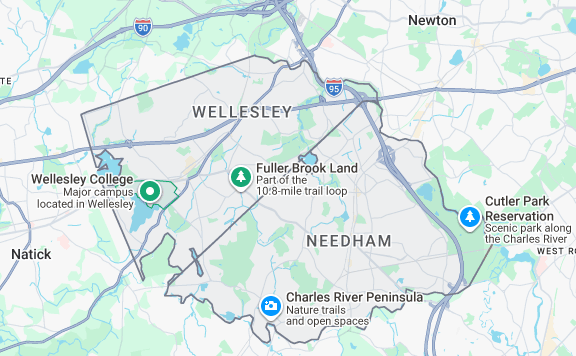
Needham is a town of roughly 33,000 people about 15 miles southwest of downtown Boston, in Norfolk County. It sits directly on Interstate 95 / Route 128 — the ring road that most of the suburban economy west of Boston depends on — and it borders Wellesley to the north, Newton to the east, Dedham to the south, and Dover to the west. The Charles River forms a meaningful stretch of its northern and western boundary, giving the town substantial conservation land and trail access.
What makes Needham different from its neighbors comes down to three things.
First, the location is unusually well-positioned for commuters. Sitting directly on I-95/Route 128 means Needham is one of the few MetroWest towns where nearly every resident is within a few minutes of a highway on-ramp. For anyone whose job sits along the 128 corridor — Waltham, Burlington, the tech and biotech belt, or even down toward Braintree — Needham is often the easiest commute of any comparable suburb.
Second, Needham has been refreshing its housing stock faster than its neighbors. Over half of the town’s currently active single-family listings were built in 2015 or later. The median year built on active Needham inventory is 2016 — in other words, half of the homes for sale in Needham right now are newer than a decade old. That is a dramatically different housing mix than most MetroWest towns, and it is a big part of why Needham has attracted buyers looking for new construction without the supply-constrained pricing of neighboring towns.
Third, Needham still feels like a real town. It has a working downtown along Great Plain Avenue, a library, a community center, meaningful conservation land, strong youth sports programs, and a parent community that shows up for school events and town meetings. It is not a bedroom community that empties out at 9 a.m. on weekdays. That matters for families, and it is one of the reasons the town has been steadily climbing on “best suburbs” lists. If you are still comparing MetroWest options broadly, my guide to the best suburbs of Boston for families breaks down ten of them side by side.
The Needham Housing Market in 2026
This is where most of my conversations with buyers start, and it is where the data for this town has changed the most over the last few years.
Here is the five-year median single-family sale price trendline for Needham, straight from MLSPIN:
| Year | Median Sale Price | Median $/sqft | Median Days on Market |
|---|---|---|---|
| 2022 | $1,455,000 | $516.37 | 12 |
| 2023 | $1,350,000 | $482.28 | 25 |
| 2024 | $1,550,000 | $502.34 | 17 |
| 2025 | $1,975,000 | $503.00 | 27 |
| 2026 YTD | $2,359,500 | $544.37 | 30 |
A few things are worth reading off this table.
Prices have climbed dramatically. Needham’s median single-family sale price is up 62% in four years. No other high-volume MetroWest town has moved like that. In 2022, Needham was genuinely the “value play” against Wellesley — you could buy in a comparable school district for about $350K less. In 2026, the relationship has inverted, and Needham’s median now runs about $462K above Wellesley’s year-to-date. I wrote a full Needham vs. Wellesley market comparison that digs into why this has happened and what it means for buyers — if you are weighing the two towns specifically, that article is the starting point.
Price per square foot has been more stable. The median $/sqft in Needham has moved from $516 in 2022 to $544 in 2026 YTD — up about 5.5% over four years. In other words, Needham’s dirt has not become dramatically more expensive. What has changed is what is being sold on that dirt: newer, bigger homes.
The market has cooled off its post-pandemic frenzy, but it is still firm. Median days on market has crept up from 12 in 2022 to 30 in early 2026. Homes that would have been gone in two weeks three years ago are now sitting for four or five. That is still fast by any historical standard, but it is a different pace than the 2021-2022 bidding-war environment, and it means buyers today usually have a little more room to think.
What is actually for sale right now
I pulled the active single-family inventory in Needham as of April 12, 2026. There are 53 active listings. Here is the breakdown:
By price band:
| Price Band | Active Listings |
|---|---|
| Under $1.0M | 8 |
| $1.0M – $1.5M | 7 |
| $1.5M – $2.0M | 14 |
| $2.0M – $3.0M | 13 |
| $3.0M – $5.0M | 10 |
| $5M and above | 1 |
| Total | 53 |
By year built:
| Era Built | Active Listings | % of Inventory |
|---|---|---|
| Pre-1900 | 3 | 6% |
| 1900–1949 | 12 | 23% |
| 1950–1999 | 11 | 21% |
| 2000–2014 | 0 | 0% |
| 2015 and newer | 27 | 51% |
The practical takeaway for a buyer: if you are looking in the $1.5M to $2M range, which is where a lot of MetroWest families actually shop, Needham currently has 14 active homes to consider. For context, the same price band in Wellesley has 4. That is not a subtle difference — it is the reason why a buyer walking into Needham with a $1.8M budget typically has a productive weekend, and the same buyer in Wellesley often walks away frustrated.
Note also the zero in the 2000-2014 row. Needham has essentially no inventory from that 15-year window right now. Almost every home for sale in Needham that is not historic is either genuinely old (pre-1950) or genuinely new (post-2015). If you want a recently-updated mid-2000s colonial, Needham is a hard town to shop — but if you want either a character home with bones or a brand-new build, the inventory is there.
Condos are a real entry point
Most of this article is about single-family homes because that is where most of the market is, but condos and townhomes are a legitimate way into Needham, particularly for downsizers, young professionals, and first-time buyers who want to plant a flag in the school district.
| Year | Median Condo Sale Price | Median $/sqft |
|---|---|---|
| 2022 | $752,500 | $380.27 |
| 2023 | $1,180,000 | $441.37 |
| 2024 | $807,500 | $478.68 |
| 2025 | $1,423,500 | $492.16 |
| 2026 YTD | $1,020,000 | $548.30 |
Condo sale prices bounce around year to year because the volume is lower (35 closings year-to-date 2026). But the 2026 picture is clean: the median Needham condo is running just above $1M. That is not cheap, but it is a meaningful alternative to a $2.36M single-family purchase if you value the school district and town amenities more than square footage. The median condo price per square foot has also climbed — from $380 in 2022 to $548 in 2026 YTD — a sign that the condo market in Needham is strengthening, not weakening.
Schools: Five Elementaries, Two Middles, and a Top-Ranked High School
Needham Public Schools is one of the main reasons families move to this town, and the district has earned the reputation. It is consistently ranked in the top 15 of Greater Boston, holds an A+ overall Niche grade, and serves about 5,200 students across a structure that looks slightly different from neighboring districts.
The elementary schools (Grades K-5):
Needham operates five neighborhood elementary schools. Your home address determines which one your child attends, and the assignments are tied to specific streets within each enrollment zone. Always verify through the Needham Public Schools district office before making an offer based on school assumptions.
- Broadmeadow Elementary — about 522 students. Known for strong academics and an active parent community. Located in southeast Needham.
- John Eliot Elementary — about 402 students. A smaller elementary with a close-knit community feel, located in central Needham near Needham Heights.
- William Mitchell Elementary — about 439 students. Strong academic performance and stable teacher tenure; serves the eastern part of town.
- Newman Elementary — about 698 students, the largest elementary in the district. Draws from a broad geographic area in western and northern Needham.
- Sunita L. Williams Elementary (formerly Hillside) — about 531 students. Renamed in 2023 in honor of the NASA astronaut and Needham native. Serves southern Needham.
Class sizes across all five schools tend to run 18-22 students. Every school has an active PTO, strong enrichment offerings, and the kind of parent involvement that signals a community genuinely invested in its schools.
Grade 6 and middle school are structured differently from most districts:
Needham is one of the few districts in the area with a dedicated Grade 6 school — High Rock — that all Needham sixth-graders attend together after finishing fifth grade at their neighborhood elementary. Students then move on to Pollard Middle School for Grades 7-8. This two-step middle school structure is intentional: it gives sixth-graders a transitional year in a smaller building focused specifically on that age group before moving into the larger Pollard environment.
Many families see this as a genuine advantage. Sixth grade is a hard transition for a lot of kids, and giving them their own school — rather than throwing them into a 7-8-9 building or a large K-8 — tends to produce stronger social and academic outcomes. Whether this structure appeals to you is a personal question, but it is a real difference between Needham and most of its neighbors.
Needham High School sits at the end of the pipeline and consistently ranks among the top public high schools in Massachusetts. It is known for a broad academic catalog — strong STEM offerings, competitive athletics, a music and arts program that draws serious participation, and a robust special education infrastructure. The facility has received meaningful investment over the last decade and continues to attract families from surrounding towns who opt into Needham over their home district.
If you are considering Wellesley as an alternative, keep in mind that both districts earn A+ Niche ratings, and neither is meaningfully “better” than the other on academic outcomes. The structural differences — six elementaries versus five, a dedicated Grade 6 school in Needham, Wellesley’s recent $250M high school rebuild — are real but small in practice. Pick the district whose structure fits your family, not the one with a marginally higher test score average. If you want to go deeper on the Wellesley side, I wrote a complete guide to every Wellesley elementary school that walks through the comparable six-school structure.
Commute: Route 128, the Needham Line, and the Real Tradeoffs
If you work in Boston, the commute is probably the second question on your list after schools, and Needham offers two main options.
By commuter rail
Needham has three stations on the MBTA Commuter Rail Needham Line: Needham Heights, Needham Center, and Needham Junction. From any of the three, the ride to Back Bay Station takes approximately 30 to 35 minutes, and then it is a short walk (or a one-stop subway connection) to South Station or the Financial District.
A few honest notes about the Needham Line:
- It runs on a branch that does not serve as many stops or as many trains per hour as some other lines. Expect roughly one inbound train per hour during rush hour, with fewer trains in the middle of the day. Check the current MBTA schedule before committing to a specific station location.
- The line does not run 24 hours, and weekend service is more limited than weekday service.
- The commute is reliable and pleasant when it runs, but the lower frequency means missing a train hurts more than it does on higher-frequency lines.
For comparison, Wellesley sits on the Framingham/Worcester Line, which has more frequent service and a slightly shorter ride (22-28 minutes to Back Bay). If commuter rail is your primary mode of getting to work, that frequency difference is worth factoring in.
By car
This is where Needham has a real advantage. The town sits directly on I-95 / Route 128, which means nearly every neighborhood in town is within five to ten minutes of a highway on-ramp. For anyone whose job is along the 128 corridor rather than downtown Boston — and that now includes a substantial share of the suburban economy, from biotech in Cambridge-adjacent Waltham to the office parks in Burlington and Lexington — Needham is one of the easiest commutes you can find.
Driving to downtown Boston takes roughly 25 to 40 minutes depending on traffic and time of day. Route 135 provides good east-west connectivity, and Route 9 is a short drive north. In short: if you drive to work, Needham is as good as it gets among the MetroWest suburbs.
A realistic take
For downtown Boston commuters, Wellesley has a slight edge on train speed and frequency. For 128-corridor commuters, Needham is clearly better. For anyone with a hybrid schedule where you are in the office two or three days a week, either town works well and the commute difference becomes less important than other lifestyle factors.
The Four Needham MLS Areas (And Why Neighborhood-Level Data Is Thin)
Needham has four formally designated MLS areas: Birds Hill, Charles River Village, Needham Heights, and Needham Junction. Locals also reference informal areas — Needham Center, the Avery neighborhood, and the area around Rosemary Lake — but only these four show up in MLS reporting.
Here is where I need to be honest with you about the data. Unlike Wellesley, where each neighborhood has enough annual sales volume to produce meaningful median price trends, the four Needham MLS areas individually are too thin to report on reliably. Listing agents in Needham often enter “Needham” as the area and leave the specific MLS area blank, so the area-tagged sales represent a small fraction of the actual activity.
To give you a sense of how thin the area-level data gets: Charles River Village has had zero closings tagged to its area in 2022, 2024, 2025, and 2026 year-to-date. Needham Junction has had one tagged closing in 2025 and partial tagging in 2026. Only Needham Heights produces enough volume (23 tagged sales in 2022, 27 in 2026 annualized) to support year-over-year trend analysis, and even Heights sees wild swings from a handful of high-end or low-end transactions.
So rather than mislead you with trend lines built on one-unit samples, here is what I can tell you from spending time in each area:
Birds Hill sits in the northwest part of Needham. It is one of the more established residential pockets in town, with classic colonials and capes on leafy streets and easy access to both Newton and Wellesley. Birds Hill has seen some of the highest individual sale prices in Needham in recent years — when a 2026 sale closed here it was at $3.025M — because the lots are larger and the housing stock includes some of Needham’s premier homes. But the volume of closings is low.
Charles River Village runs along the town’s northwest edge near the river. It has a quieter, more wooded feel than the rest of Needham, and the housing stock is a mix of older homes and some newer construction along Central Avenue. Genuine charm, but very little on-market activity in most years.
Needham Heights is in the north-central part of town and is the most active of the four MLS areas. It has the Needham Heights commuter rail station, strong walkability to some of Needham’s best retail along Chestnut Street and Highland Avenue, and a housing mix that runs the full range from $1M capes to $2.5M+ new construction. Sale prices have been volatile here — the 2025 median fell to $1.1M on just three tagged sales, then jumped to $2.5M on seven tagged sales in 2026 YTD — but the overall direction is clearly up.
Needham Junction is in the southern part of town, anchored by the Needham Junction commuter rail station. It is the least affluent of the four named areas historically and tends to attract first-time buyers and younger families because entry prices have historically been lower. The area is seeing more activity in 2026 as builders have started renovating and flipping older homes here.
My practical advice: Needham is a town where the town-wide data is much more reliable than the neighborhood-level data. For most buyers, the right approach is to identify the commuter rail station you want to be near, the elementary school district you want, and the price band you can shop — and then look at what is for sale across the whole town that meets those three criteria. Trying to pick a Needham “neighborhood” the way you might in Wellesley or Newton is often a false precision.
If you want a deeper dive on how Wellesley organizes itself by comparison, my guide to the best neighborhoods in Wellesley walks through how that town works by area — it is structurally more neighborhood-driven than Needham.
Downtown Needham and Lifestyle
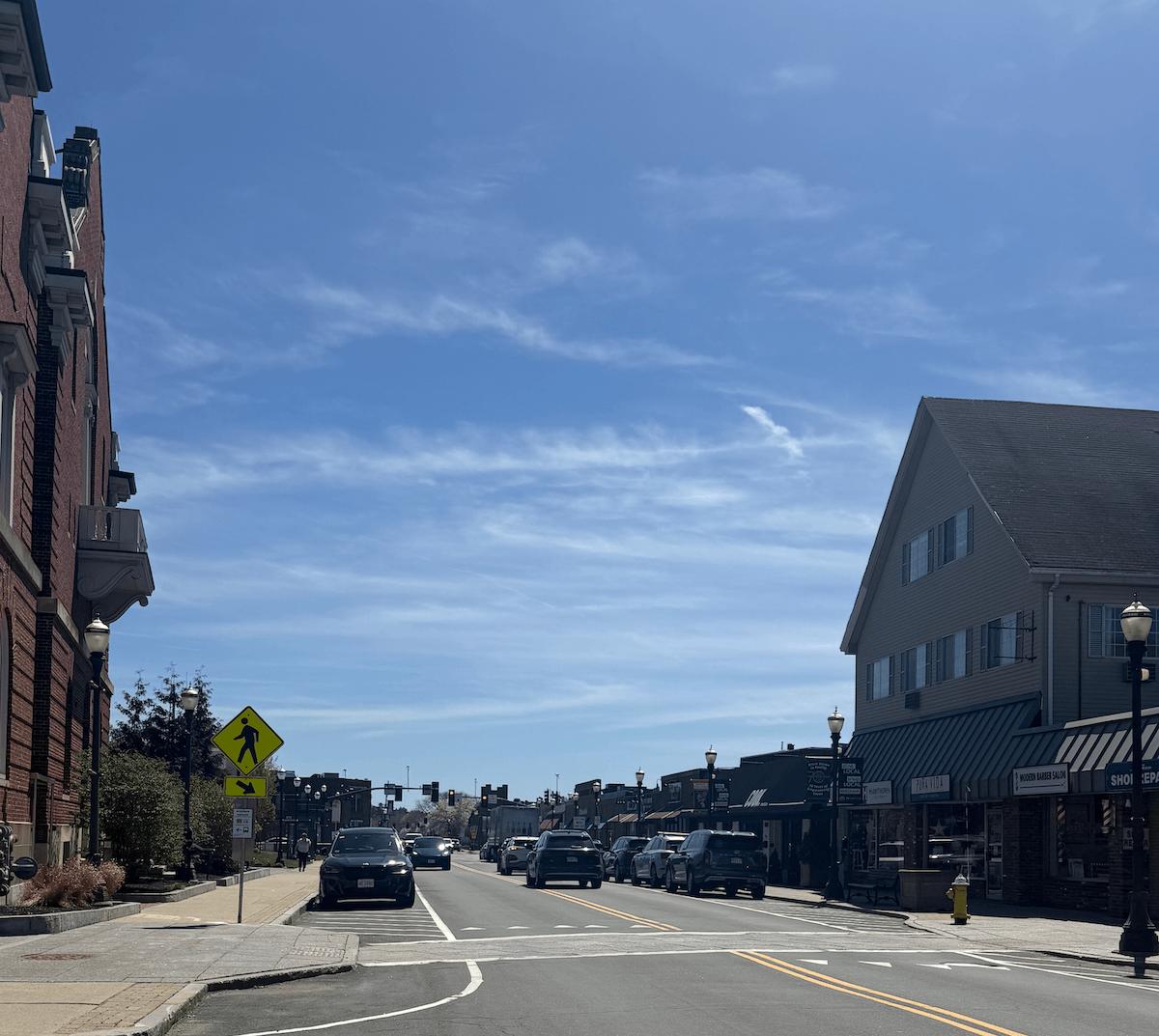
Downtown Needham runs along Great Plain Avenue and Chestnut Street, anchored by the Needham Center commuter rail station. It is a genuine working downtown — restaurants, coffee shops, a bookstore, the Needham Public Library, the Center at the Heights community center, and the kind of independent retail that most suburbs have lost over the last two decades.
What I notice when I walk through downtown Needham, compared to downtown Wellesley:
- It feels less self-consciously affluent. Wellesley Square can feel like a magazine shoot in parts; Needham Center feels more like a real place where real people get coffee and pick up dry cleaning. That is not a knock on Wellesley — some buyers specifically want the polish — but it is a different vibe.
- Restaurants skew more casual. There is good food in Needham, but the emphasis is more on neighborhood pubs, family-friendly spots, and ethnic cuisine than fine dining.
- Parking is easier. Downtown Needham has more parking capacity than Wellesley Square, which matters on Saturday mornings.
- The library is a genuine civic anchor. The Needham Public Library runs serious programming — adult lectures, children’s series, teen programs — and the space itself is comfortable and well-used.
Outside of downtown, Needham has:
- Charles River Reservation access with significant trail mileage along the river
- Ridge Hill Reservation — about 260 acres of conservation land in the southwest part of town
- Rosemary Lake (Memorial Park) — a town pond with summer swimming and year-round walking trails
- Strong youth sports programs — Needham baseball, soccer, and hockey organizations are well-established and draw serious participation
- An active adult community at the Center at the Heights — this is an underrated amenity for multigenerational families where grandparents are nearby
- Local events — including the Needham Farmers Market in summer, the town’s Fourth of July parade and celebration, and the Thanksgiving Day football game against Wellesley (one of the oldest high school football rivalries in the country, and genuinely a town event)
For a family with young kids, Needham delivers on essentially every lifestyle metric that makes a suburb livable: libraries, sports, open space, downtown walkability in pockets, and a school system that is the center of community life. It is not flashy, but it is deeply functional.
Cost of Living in Needham Beyond the Mortgage
Most “cost of living in Needham” conversations start and end with home prices, but families relocating should know a few other numbers.
Property taxes: Needham’s residential property tax rate is competitive with neighboring towns but not the lowest. On a $2M home, expect annual property taxes in the low-to-mid $20,000 range. The exact rate varies year to year — check the current Needham Assessor’s office website for the latest mill rate.
Utilities and services: Trash and recycling are included in property taxes. Water and sewer are separately billed. Heating costs (oil, gas, or electric, depending on the home) vary widely — a drafty 1920s colonial can cost two or three times what a 2020 build costs to heat, and this is often underappreciated by buyers coming from warmer climates.
Car insurance: Massachusetts has high insurance rates overall, but Needham’s rates are moderate for the state. If you are coming from a lower-insurance state, this is often a meaningful adjustment.
Groceries and dining: Needham has Roche Bros, Whole Foods (nearby in Dedham and Wellesley), and smaller specialty shops. Grocery prices run about 10-15% above the national average, consistent with Greater Boston broadly.
Childcare: If you have preschool-age kids, Needham’s daycare and preschool costs are in line with the MetroWest average — expect $20,000 to $30,000 per year for full-time care, with top-rated programs running higher.
The real cost of living factor in Needham, as in Wellesley, is the home purchase itself. Once you are in, ongoing costs are manageable; the hurdle is getting in.
Pros and Cons of Living in Needham
I try to be honest with clients, so here is a straight list.
Pros
- Top-ranked schools — the district is genuinely excellent, and the structural design (five neighborhood elementaries, dedicated Grade 6 at High Rock, strong high school) works well for most families
- Easy highway access — sitting directly on I-95 / Route 128 makes Needham one of the best-positioned MetroWest towns for commuters whose jobs are not in downtown Boston
- Substantial new construction — over half of active inventory is less than a decade old, which is unusual for MetroWest and a real differentiator for buyers who do not want to renovate
- Functional downtown — walkable, relaxed, and still has independent retail
- Strong community feel — active parent networks, well-attended town events, genuinely high civic participation
- More inventory at mid-price bands — if you are shopping $1.5M–$2.0M, Needham gives you more to choose from than most comparable towns
- Better value per square foot than Wellesley — you get more house for your dollar here
Cons
- Prices have climbed dramatically — Needham is no longer the “value play” it was in 2022. The 62% median price increase means anyone entering the market today is paying a premium over recent years
- Commuter rail is less frequent — the Needham Line runs fewer trains per hour than Wellesley’s Framingham/Worcester Line, and missing one hurts more
- Some areas trade lot size for new construction — many of the newest builds sit on smaller lots because builders have maxed out existing parcels. If you want acreage, Needham is harder than Dover or Weston
- Downtown is functional but not a destination — Needham Center is pleasant but does not have the retail mix or restaurant depth of Wellesley Square or Newton Centre
- Higher property taxes than some comparable towns — Newton and Brookline are in a similar range; Weston and Wellesley are slightly more favorable in some years
- School boundary changes are possible — like any growing district, Needham occasionally redraws enrollment lines. If school assignment is critical to your decision, verify with the district office before closing
Who Should Choose Needham
Based on hundreds of conversations with buyers over the last few years, here is my honest framework:
Needham is probably right for you if:
- You want an excellent school district without paying the absolute top of the market for the address
- You value new construction or recently-built homes and do not want a major renovation
- Your commute is along the Route 128 corridor rather than downtown Boston
- You want a real community with civic engagement and active parent networks
- You are shopping in the $1.5M to $3M range and want meaningful inventory to choose from
- You care more about the school district and community than about being in the most prestigious ZIP code on the map
Needham might not be right for you if:
- You specifically want a walkable, village-scale downtown as a daily lifestyle — Wellesley Square or Newton Centre will deliver that better
- You want a large lot (2+ acres) — look at Dover or Weston
- Your commuter rail ride needs to be as short and frequent as possible — Wellesley or Newton are better
- You are shopping above $5M and want deep luxury inventory — Wellesley currently has far more active homes in that band
- You want an older, character-driven housing stock with lots of pre-1940s architecture — Wellesley and Newton have more of it
If you are still torn between Needham and Wellesley specifically, my detailed Needham vs. Wellesley comparison walks through the data side by side and traces why the two towns have moved in opposite directions since 2022. That article is a deeper dive into the specific comparison.
Frequently Asked Questions
Yes. Needham is consistently ranked among the top suburbs of Boston for families, with an A+ rated school district, direct access to I-95/Route 128 and commuter rail service to Back Bay, substantial conservation land, and an engaged community. Median home prices reflect that demand — the 2026 year-to-date median single-family sale price is $2,359,500.
Yes, Needham is firmly in the wealthiest tier of Massachusetts suburbs. The median household income is well above state and national averages, and the 2026 median single-family sale price of $2.36M puts Needham second only to Weston among the major MetroWest towns.
Needham is in Norfolk County, Massachusetts.
About 15 miles by road, typically a 25 to 40 minute drive depending on traffic. By MBTA commuter rail, the ride from Needham to Back Bay Station is approximately 30 to 35 minutes.
Needham has five public elementary schools: Broadmeadow, John Eliot, William Mitchell, Newman, and Sunita L. Williams Elementary (formerly Hillside, renamed in 2023). Each serves a specific geographic enrollment zone within the town.
High Rock serves Grade 6 only. All Needham sixth-graders attend High Rock together before moving on to Pollard Middle School for Grades 7-8. This dedicated Grade 6 school is one of the structural features that distinguishes Needham’s district from most neighboring towns.
As of 2026 year-to-date (through April 12), the median single-family sale price in Needham is $2,359,500, and the average sale price is approximately $2,267,000. Prices have climbed roughly 62% over the last four years.
Year-to-date 2026, the median single-family sale price in Needham ($2,359,500) is running above Wellesley ($1,897,500) — a reversal of a long-standing pattern. However, Wellesley still commands a higher price per square foot, meaning Needham buyers are purchasing larger or newer homes for similar total dollars. For a complete breakdown, read my Needham vs. Wellesley comparison article.
The four formal MLS areas are Birds Hill, Charles River Village, Needham Heights, and Needham Junction. In practice, many sales are tagged only to “Needham” without specifying an area, so neighborhood-level price data is thin and not a reliable basis for decision-making.
Yes. Three stations on the MBTA Commuter Rail Needham Line serve the town: Needham Heights, Needham Center, and Needham Junction. Trains reach Back Bay Station in approximately 30 to 35 minutes, though service is less frequent than on lines serving nearby towns like Wellesley.
Thinking About a Move to Needham?
Needham has changed more over the last four years than most Boston suburbs have changed in a decade. The price climb is real, the new construction is real, and the town’s position as one of the strongest MetroWest options for families is real.
If you are starting your search, the most useful thing I can do is walk you through specific homes, specific streets, and the specific school zones that fit your family. Every buyer’s priorities are different — some need to be walking distance to a commuter rail station, some care more about lot size, some have strong opinions about which elementary their kids will attend — and the right home in Needham depends on which of those levers matters most to you.
If you want to start looking, you can browse current homes for sale in Needham or get in touch with me directly to talk through your situation. I work in Needham every week, I know which streets are under-listed and which are overpriced, and I can save you a lot of weekends driving around wondering what you are actually looking at.
Here is to finding the right home for your family — in Needham or wherever you end up.
— Sneha
Needham has changed more over the last four years than most Boston suburbs have changed in a decade. The price climb is real, the new construction is real, and the town’s position as one of the strongest MetroWest options for families is real.
If you are starting your search, the most useful thing I can do is walk you through specific homes, specific streets, and the specific school zones that fit your family. Every buyer’s priorities are different — some need to be walking distance to a commuter rail station, some care more about lot size, some have strong opinions about which elementary their kids will attend — and the right home in Needham depends on which of those levers matters most to you.
If you want to start looking, you can browse current homes for sale in Needham or get in touch with me directly to talk through your situation. I work in Needham every week, I know which streets are under-listed and which are overpriced, and I can save you a lot of weekends driving around wondering what you are actually looking at.
Here is to finding the right home for your family — in Needham or wherever you end up.
— Sneha
Sneha Patel is a real estate advisor with Gibson Sotheby’s International Realty, based in Wellesley, MA. She is a Wellesley resident, parent, former PTO president at Sprague Elementary School, and active community volunteer. She specializes in helping families find homes across Wellesley, Needham, Newton, Dover, Weston, and Wayland. Get in touch | (781) 316-4800