By Sneha Patel | Gibson Sotheby’s International Realty
One of the first things families ask me when they start looking at Wellesley is “which neighborhood should we be in?” It is the right question and the honest answer is that the best neighborhoods in Wellesley, MA are all strong. There is no area of town you would want to avoid. But they are not all the same, and the differences matter more than most people realize until they are living here.
Wellesley is a town of roughly 30,000 people spread across more than a dozen distinct areas, each with its own character, price range, and relationship to the town’s three commuter rail stations. Some neighborhoods are walkable to shops and restaurants. Others are quiet, estate-style enclaves where your nearest neighbor is behind a wall of mature trees. Some feel like classic New England postcard suburbs. Others have a more modern, recently developed energy.
As someone who lives in Wellesley, has raised my family here, and helps clients find the right part of town every week, I know that where you live within Wellesley shapes your daily life just as much as the decision to move here in the first place. This guide walks through every major area in town so you can start narrowing your search before you ever schedule a showing. If you’re still weighing Wellesley against towns like Needham, Newton, or Natick, our guide to the best suburbs of Boston for families breaks down schools, commute, and home prices across ten top towns.
- How Wellesley’s Neighborhoods Work
- Wellesley Hills
- The Country Club
- Wellesley Square / Downtown
- Linden Square / Linden Street Area
- Wellesley Farms
- Poets Corner
- Overbrook
- Cliff Estates / Peirce Estates
- Dana Hall Area
- Fells
- Wellesley Lower Falls
- Bates Area
- How to Choose the Right Wellesley Neighborhood
- Frequently Asked Questions
- Finding Your Neighborhood
How Wellesley’s Neighborhoods Work
Before diving in, a few things worth understanding about how Wellesley is organized.
Wellesley does not have officially designated neighborhoods the way some cities do. There are no formal boundary lines drawn by the town government. But locals absolutely think in terms of areas, Wellesley Hills, The Country Club, Wellesley Square, Wellesley Farms, Cliff Estates, Poets Corner, and others and so does the real estate market. When an agent or a neighbor references one of these areas, everyone in town knows exactly what they mean.
Three things should anchor your neighborhood search. First, commute: Wellesley has three MBTA commuter rail stations on the Framingham/Worcester Line. They are Wellesley Square, Wellesley Hills, and Wellesley Farms, each putting you in Back Bay in 22 to 28 minutes. Which station you are closest to shapes your daily routine. Second, walkability: some areas are a short walk to shops, restaurants, and the train, while others require a car for everything. Third, elementary school: your home address determines which of Wellesley’s six elementary schools your child attends, and boundaries were redrawn in 2024. We wrote a detailed guide to every Wellesley elementary school if you want to understand how that works.
One important note: school district boundaries do not always follow neighborhood boundaries neatly. Several neighborhoods in this guide straddle two school districts, meaning one side of a street might feed one school while the other side feeds another. I will note where this happens, but always verify your specific address using the WPS street lookup tool before making any decisions based on school assignment.
With that context, let us tour the town. Here is a general map of the neighborhoods that you can download if you’d like to visually follow along with the articles exploration of each neighborhood.
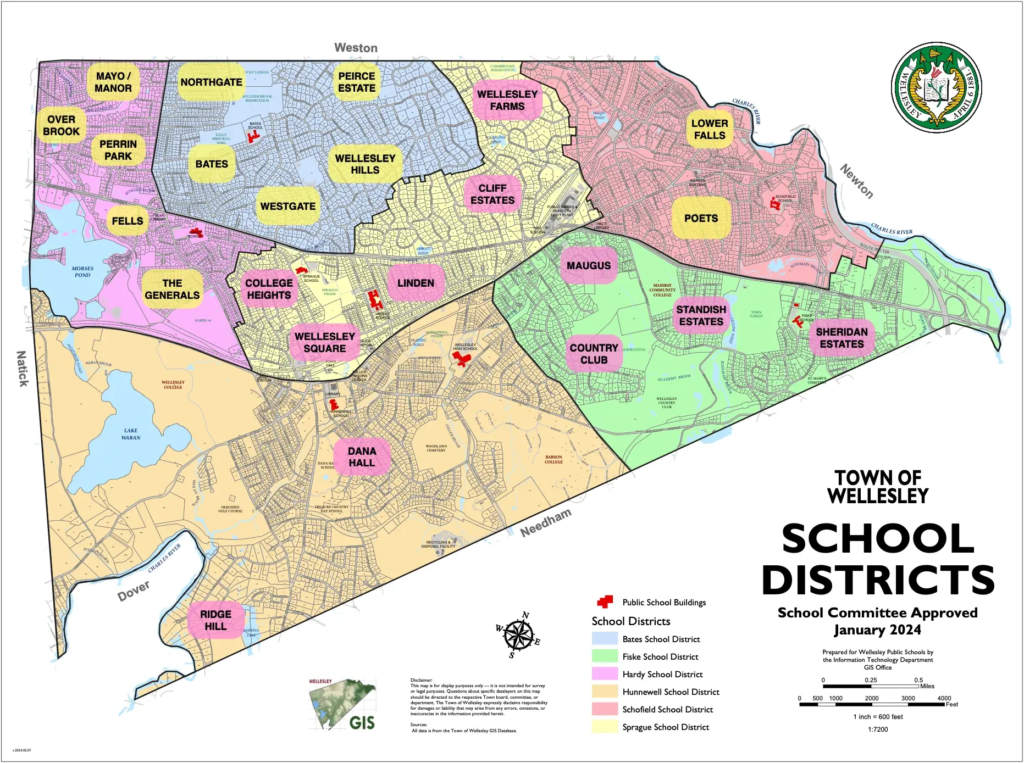
Source: Town of Wellesley GIS / Wellesley Public Schools, January 2024
Wellesley Hills
Commuter rail: Wellesley Hills station | Elementary schools: Bates or Sprague (varies by street)
Wellesley Hills sits in the central part of town near the Wellesley Hills commuter rail station. It is one of the areas that people picture when they think of Wellesley, tree-lined streets, well-maintained homes, and a quiet, established residential character.
The Wellesley Hills commuter rail station provides direct service to Back Bay, and the small commercial area along Route 16 has restaurants, a dry cleaner, a coffee shop, and other everyday conveniences. The neighborhood draws families who want commuter rail access without being right in the bustle of Wellesley Square.
Home styles here include classic colonials, expanded capes, and some newer construction, with prices generally ranging from $1.5M to $3M depending on the street, lot size, and condition. The neighborhood has a mature, settled feel with big trees, established landscaping, and sidewalks that invite walking.
An important detail for families: Wellesley Hills straddles two school districts. Depending on your exact street, your child may attend either Bates Elementary or Sprague Elementary. Both are excellent, but the assignment matters – always check before you make an offer.
Best for: Families who want commuter rail access, a central location, and a classic Wellesley residential feel.
The Country Club
Commuter rail: Near Wellesley Hills station | Elementary school: Primarily Fiske
The Country Club neighborhood takes its name from its proximity to Wellesley Country Club and sits south of Wellesley Hills. This is one of Wellesley’s most prestigious and sought-after areas, known for its rolling, winding streets, generous lots, and stately homes.
The streets here curve rather than grid and roads wind around hills and mature trees, traffic is light, and the overall feeling is spacious and private. This is an estate-style neighborhood where homes sit back from the road on well-landscaped lots, many with circular driveways and stone walls. Architectural styles lean toward classic colonials, Tudors, and expanded traditional homes, with a growing number of high-end new construction homes filling in where older properties have been torn down. Babson College is also nearby, which adds some cultural programming and energy to the area.
Home prices in The Country Club area center around a median of approximately $2.2 million, with smaller or older homes starting around $1.5M and larger estates reaching $4M and above. Families in this area tend to be well-established. This is not typically a first home in Wellesley neighborhood, though updated homes on the lower end of the range do attract move-up buyers.
Children in The Country Club area primarily attend Fiske Elementary, one of the district’s well-established schools with a strong academic reputation and active parent community.
Best for: Families who want space, privacy, a prestigious address, and a neighborhood that feels quietly grand – with proximity to Wellesley Country Club and Babson College.
Wellesley Square / Downtown
Commuter rail: Wellesley Square station | Elementary school: Hunnewell or Sprague (varies by street)
If The Country Club is the estate neighborhood, Wellesley Square is the village. This is the walkable heart of town and the commercial and social center where Saturday mornings mean browsing at Wellesley Books, grabbing coffee, and running into neighbors at Roche Bros.
The Square has genuine small-town energy that larger suburbs cannot replicate. The shops are mostly independent and locally owned. The restaurants range from casual to upscale. The public library is steps from the center. And the Wellesley Square commuter rail station sits right in the middle of it all, making this one of the most convenient locations in town for commuters.
Housing around the Square is more varied than in other Wellesley neighborhoods. You will find condos and town homes starting in the $700K to $1.4M range. A genuine entry point for buyers who want to be in Wellesley without the $2M+ price tag that dominates other areas. Radiating out from the center are historic colonials, Victorians, and Craftsman-style homes on tree-lined streets, typically ranging from $1.5M to $3.5M. Some of these homes are among the oldest in Wellesley and carry real architectural character.
Wellesley College’s campus is a short walk from the Square, and Lake Waban. One of the most beautiful walks in town is open to the public. It is a local favorite for morning jogs, evening strolls, and weekend family outings.
Most families in the Wellesley Square area attend the brand-new Hunnewell Elementary School, which opened in February 2024. A state-of-the-art facility that families buying in this district benefit from right now. However, some streets on the edges of the Square area fall into the Sprague Elementary district, so always verify your address.
Best for: Younger families, downsizers, professionals, and anyone who values walkability and a village-center lifestyle above all else.
Linden Square / Linden Street Area
Commuter rail: Near Wellesley Hills station | Elementary school: Sprague
The Linden Street area sits in the central-eastern part of Wellesley, anchored by Linden Square – a commercial development that has become one of the town’s gathering spots. The Square features shops, restaurants, and services that draw from both the immediate neighborhood and the broader area.
The residential streets around Linden Street are among Wellesley’s most established. Homes here tend to be classic colonials and capes on well-maintained lots with mature landscaping. These are the kind of streets that look exactly the way you would want a New England suburb to look. The area is close to Wellesley College, and a walk around Lake Waban is just minutes away.
Home prices in the Linden Street area typically range from $1.5M to $3M, depending on lot size, condition, and proximity to the commercial center. The neighborhood draws families who want a balance of residential quiet and convenient access to shops and dining without being right in the bustle of Wellesley Square.
Children in this area attend Sprague Elementary, one of the larger schools in the district with 19 classrooms and a reputation for strong parent community involvement. As a former PTO president at Sprague, I can vouch for the school’s welcoming culture and the community that forms around it.
Best for: Families who want an established, family-oriented neighborhood with easy access to local amenities, Wellesley College’s campus, and the Sprague Elementary community.
Wellesley Farms
Commuter rail: Wellesley Farms station | Elementary school: Sprague or Schofield (varies by street)
Wellesley Farms occupies the northwestern corner of town, bordering Weston and Newton. If you are looking for large lots, grand homes, and a more secluded feel, this is where your search will likely lead.
The area has its own commuter rail station, Wellesley Farms, making it a strong commuter location despite feeling more removed from the center of town. The Mass Pike is easily accessible, and the Charles River is nearby. Streets here were developed primarily in the 1920s and 1930s, giving the neighborhood a gracious, established character with some of Wellesley’s largest and most impressive homes. In recent years, significant new construction has also appeared, with modern estates on generous lots pushing the top of the market.
Home prices in Wellesley Farms are among the highest in town, typically ranging from $2M to $4M and above. New construction regularly exceeds $3M. This is not a starter-home neighborhood, it is where established families seeking maximum space and a prestigious setting tend to land.
The neighborhood is more residential than commercial. You will not walk to a coffee shop from here the way you would from Wellesley Square. But that is the trade-off residents happily make for the privacy, lot sizes, and the quality of the housing stock.
Families in Wellesley Farms should be aware that the area straddles two school districts – some streets feed Sprague Elementary while others feed Schofield Elementary. Both are strong schools, but the boundary line runs through this neighborhood, so verify your specific address.
Best for: Families who want large lots, grand or newly built homes, their own commuter rail station, and a more private, estate-like setting.
Poets Corner
Commuter rail: Near Wellesley Hills or Wellesley Farms stations | Elementary school: Schofield
Poets Corner is one of Wellesley’s most charming neighborhoods, and it is often where families who want to be in Wellesley but do not need or want an estate-style home end up finding their fit. The streets are named after American poets – Longfellow, Emerson, Whittier, Lowell – which gives the neighborhood a character that is hard to forget.
The homes here tend to be capes, colonials, and older New England styles on more modestly sized lots compared to The Country Club or Cliff Estates. “Modest” is relative in Wellesley, of course, but Poets Corner offers a more accessible entry point with homes typically ranging from $1.5M to $2.4M. For families relocating from Boston or Cambridge who are experiencing sticker shock at Wellesley prices, this is often the neighborhood that makes the numbers work.
Poets Corner has easy access to both the Wellesley Hills and Wellesley Farms commuter rail stations, and sits close to Cedar Street and the Schofield Elementary School area.
Children in Poets Corner attend Schofield Elementary, a well-established school with 18 classrooms and a dedicated parent community.
Best for: Families who want to be in Wellesley at a relatively more accessible price point, with charming streets, character homes, and convenient commuter rail access.
Overbrook
Commuter rail: Near Wellesley Farms station | Elementary school: Hardy
Overbrook sits on the western side of Wellesley, located west off Weston Road. It is a distinct neighborhood from Poets Corner (which is on the other side of town), though both offer a more accessible entry point to Wellesley.
The area features a mix of older homes and newer construction, with prices ranging from roughly $1.5M to $3M depending on lot size and whether the home has been updated or rebuilt. New construction in Overbrook can push into the low $3M range. The neighborhood has easy access to Route 9 and sits close to the Wellesley Farms commuter rail station.
Overbrook has a quieter, more residential character. Families here value the space and the proximity to conservation land, which offers more of a nature-adjacent feel than the areas closer to Wellesley Square.
Children in the Overbrook area attend Hardy Elementary, one of the district’s two brand-new school buildings, which opened in August 2024. It is an 80,000 square-foot, net-zero energy ready facility. Families buying in this district right now benefit from genuinely modern infrastructure.
Best for: Families looking for a quieter setting with newer construction options, proximity to the Wellesley Farms station, and access to the brand-new Hardy Elementary.
Cliff Estates / Peirce Estates
Commuter rail: Near Wellesley Hills station | Elementary school: Cliff Estates is Sprague or Bates (varies by street); Peirce Estates is primarily Bates
If you are looking for Wellesley’s most prestigious addresses, this is it. Cliff Estates and the adjacent Peirce Estates represent the pinnacle of the town’s residential real estate. Grand homes on large lots with a level of privacy and scale that is increasingly rare in the inner suburbs.
Cliff Estates is located in the western part of town, characterized by winding roads, mature trees, and timeless architecture. Lot sizes typically range from half an acre to over an acre. Home styles include classic colonials, Tudors, French-inspired estates, and newer custom builds, generally ranging from 4,000 to over 7,000 square feet.
The Peirce Estates were developed slightly later, in the 1960s, and tend to have even larger lots than Cliff Estates. Between the two areas, home prices range from approximately $2.5 million to well over $5 million, with select properties exceeding $10 million. These neighborhoods consistently rank among the highest in Wellesley for average sale price.
Despite the estate-style living, the location is surprisingly practical. The Wellesley Hills commuter rail station is nearby, Route 9 and the Mass Pike are easily accessible, and Boulder Brook Reservation offers walking and biking trails right at the neighborhood’s edge. Wellesley Country Club is also adjacent, offering golf, tennis, swimming, and social programming for member families.
Note that Cliff Estates straddles school district boundaries, some streets fall in the Sprague district and others in the Bates district. Peirce Estates primarily feeds into Bates Elementary. As always, verify your specific address.
Best for: Established families with a larger budget who want maximum space, privacy, and one of the most prestigious residential addresses in Greater Boston.
Dana Hall Area
Commuter rail: Near Wellesley Square station | Elementary school: Hunnewell
The Dana Hall area takes its name from Dana Hall School, the well-known private girls’ school located here. While Dana Hall itself is a private institution, families living in this neighborhood who attend public schools are in the Hunnewell Elementary district.
This is a beautiful pocket of Wellesley tucked near the center of town, with a mix of classic colonials, expanded capes, and some newer construction on tree-lined lots. Home prices typically range from $1.8M to $3.5M. The area benefits from proximity to both Wellesley Square’s walkable amenities and the campus of Wellesley College, with access to Lake Waban and the college’s Botanic Gardens.
The neighborhood has a quieter, more academic feel than the Square itself, you are close enough to walk to shops and restaurants but far enough to enjoy a genuinely residential setting.
Children attending public school in the Dana Hall area go to Hunnewell Elementary, the brand-new facility that opened in February 2024. Families here benefit from one of the newest school buildings in the region combined with a charming, centrally located neighborhood.
Best for: Families who want a central location near Wellesley Square and Wellesley College, with the new Hunnewell Elementary as their neighborhood school.
Fells
Commuter rail: Nearest to Wellesley Farms station | Elementary school: Hardy
The Fells is a distinctly different area from Dana Hall – located on the western side of Wellesley, it is characterized by mature trees, conservation land, and a secluded, wooded feel. This is one of the quieter, more nature-oriented neighborhoods in town.
Homes in the Fells area sit on generous lots surrounded by greenery. The area borders conservation land and offers a feeling of being tucked into the woods even though you are minutes from Route 9 and the Wellesley Farms commuter rail station. Home prices typically range from $1.8M to $4M depending on lot size and condition.
This is a neighborhood for families who value quiet and nature above walkable convenience. You will not walk to shops or restaurants from here. But you will walk to wooded trails and enjoy some of the most peaceful streets in town.
Children in the Fells area attend Hardy Elementary, the brand-new school building that opened in August 2024.
Best for: Families who want a quieter, nature-oriented setting with large lots, mature trees, and proximity to conservation land.
Wellesley Lower Falls
Commuter rail: Closest to Wellesley Hills station (drive) | Elementary school: Schofield
Wellesley Lower Falls sits in the northeastern corner of town, bordering Newton Lower Falls. It has a different feel from the rest of Wellesley, more connected to the Route 9 corridor and Newton’s commercial infrastructure than to Wellesley’s village centers.
The area offers proximity to Whole Foods, Roche Bros, and other shopping along Route 9, as well as relatively easy access to the Mass Pike. The Charles River runs nearby, and the neighborhood has some of the most accessible entry points for home buyers who want a Wellesley address without the price premiums of the central neighborhoods.
Home prices in Wellesley Lower Falls typically range from $1.2M to $2.5M. Making this one of the more budget-friendly areas of town. Housing stock includes a mix of ranches, capes, split-levels from the mid-20th century, and some newer construction.
The trade-off is walkability and neighborhood identity. Lower Falls does not have its own commercial center or commuter rail station the way Wellesley Square or Wellesley Hills do. Most residents here are car-dependent for daily errands. But for families who prioritize Wellesley’s schools and need highway access for their commute, it is a practical and underappreciated option.
Children in Wellesley Lower Falls attend Schofield Elementary.
Best for: Budget-conscious families who want Wellesley schools and a Wellesley address with easier highway access, and who do not need a walkable town center nearby.
Bates Area
Commuter rail: Closest to Wellesley Hills or Wellesley Farms stations | Elementary school: Bates
The Bates area occupies the northern part of Wellesley, abutting Weston and the Boulder Brook Reservation. This is one of Wellesley’s most family-centric neighborhoods. It is the kind of place where kids ride bikes to each other’s houses and parents gather at Perrin Park on weekend mornings.
Perrin Park is a centerpiece of this area and one of the most popular family parks in town. Many streets in the neighborhood lead directly to the park, creating a natural gathering spot that builds community. You will find a high concentration of young families here, drawn by the neighborhood’s kid-friendly character and relatively reasonable (for Wellesley) price range.
Homes in the Bates area date primarily from the 1950s through the 2000s, with a mix of colonials, capes, and ranches on tree-lined streets. Prices typically range from $1.7M to $3.2M. Bates Elementary is accessible via a neighborhood pathway at the corner of Beverly and Wingate roads, making the walk to school easy and safe for families who live nearby.
The neighborhood has easy Mass Pike access and sits close to the Boulder Brook Reservation, which offers trails and green space right at the edge of the neighborhood. It is less walkable to shops and restaurants than the Square or Hills areas, but the family-oriented character more than makes up for it in the eyes of most residents.
Best for: Families with young children who want a neighborhood where kids play outside, neighbors know each other, and the elementary school is a short walk through the neighborhood.
How to Choose the Right Wellesley Neighborhood
After reading through these distinct areas, you might feel like you need a spreadsheet. Here is a simpler framework.
If walkability is your top priority: Wellesley Square. Nothing else in town comes close for walk-to-everything convenience.
If you want the “classic Wellesley” estate feel: The Country Club or Cliff Estates. Grand homes, rolling lots, winding roads.
If you need the most accessible entry price: Poets Corner, Overbrook, Wellesley Lower Falls, or a condo near Wellesley Square. These areas offer Wellesley schools and community at a lower price floor.
If you want the newest school building: Dana Hall area and Wellesley Square (Hunnewell Elementary, opened Feb 2024) or Overbrook and the Fells (Hardy Elementary, opened Aug 2024).
If young kids and a family-neighborhood feel matter most: The Bates area. Perrin Park, neighborhood pathways to school, and a community built around families with children.
If space and privacy are non-negotiable: Wellesley Farms or Cliff Estates. Largest lots, most seclusion.
A critical reminder: School district boundaries do not always follow neighborhood boundaries. Many of the areas in this guide straddle two districts, meaning your elementary school depends on your exact street address, not just which neighborhood you are in. Always verify using the WPS street lookup tool before making decisions based on school assignment. As a local agent, helping families navigate this is something I do regularly and it is one of those details that can be counterintuitive until you have seen the map.
And the most important advice I can give: visit in person. Drive through on a Saturday morning. Walk the streets at school drop-off time. Stop at the local coffee shop and watch the neighborhood happen. Every area of Wellesley looks good on paper, the question is which one feels like home when you are standing in it.
If you would like a personal tour of these neighborhoods, I am happy to drive you through and share what I know from living here. That is often the fastest way to narrow your search. And once you have a neighborhood in mind, my insider’s guide to buying a home in Wellesley walks through the rest of the process including budgeting, showings, and making a confident offer. Let’s connect when you are ready.
Frequently Asked Questions
What are the best neighborhoods in Wellesley, MA? All of Wellesley’s neighborhoods are desirable. The best one for you depends on your budget, commute needs, and lifestyle preferences. The Country Club and Cliff Estates are the most prestigious, Wellesley Square is the most walkable, Poets Corner and Lower Falls are the most accessible price points, and the Bates area is the most family-centric.
What is the most expensive neighborhood in Wellesley? Cliff Estates and Peirce Estates are consistently the highest-priced areas, with homes ranging from approximately $2.5M to over $10M. Wellesley Farms and The Country Club are also at the top of the market, with estates and new construction regularly exceeding $3M.
What is the most affordable neighborhood in Wellesley? Wellesley Lower Falls, Poets Corner, and Overbrook offer more accessible entry points, with homes starting in the $1.2M to $1.5M range. Condos near Wellesley Square can start below $800K.
How many commuter rail stations does Wellesley have? Three, they are Wellesley Square, Wellesley Hills, and Wellesley Farms, all on the MBTA Framingham/Worcester Line. Service runs to Back Bay in approximately 22 to 28 minutes depending on the station.
Does your neighborhood determine your elementary school in Wellesley? Your home address determines your school, but neighborhood and school district boundaries do not always align perfectly. Many neighborhoods in Wellesley straddle two school districts, meaning your specific street determines the assignment. Always use the WPS street lookup tool to verify, or read our complete guide to Wellesley elementary schools.
Where should I live in Wellesley if I commute to Boston? For the shortest walk to the train, Wellesley Square is the best option – the station is in the center of town surrounded by homes and condos. Wellesley Hills and Wellesley Farms each have their own stations as well, offering slightly different neighborhood characters with equally convenient commuter rail access.
Finding Your Neighborhood
Wellesley is a town where every neighborhood has something to offer, exceptional schools, strong property values, and a genuine sense of community. The differences come down to lifestyle: how you want to spend your mornings, how you get to work, how much space you need, and what kind of streetscape makes you feel at home.
The best way to find your fit is to visit. And if you want a local perspective, someone who can tell you which streets flood in a nor’easter, which parks are packed with kids on Saturday mornings, and which neighborhoods are seeing the most new construction, I am here for that conversation.
I chose Wellesley for my own family, and I would love to help you find the part of town that feels right for yours.
Read my insider’s guide to buying a home in Wellesley | Explore homes for sale in Wellesley | Let’s connect
Sneha Patel is a real estate advisor with Gibson Sotheby’s International Realty, based in Wellesley, MA. She is a Wellesley resident, former PTO president at Sprague Elementary School, and active community volunteer. She specializes in helping families find homes across Wellesley, Needham, Newton, Dover, Weston, Wayland, and the surrounding MetroWest communities. Get in touch | (781) 316-4800